Focaccia
Olive Oil & Sea Salt
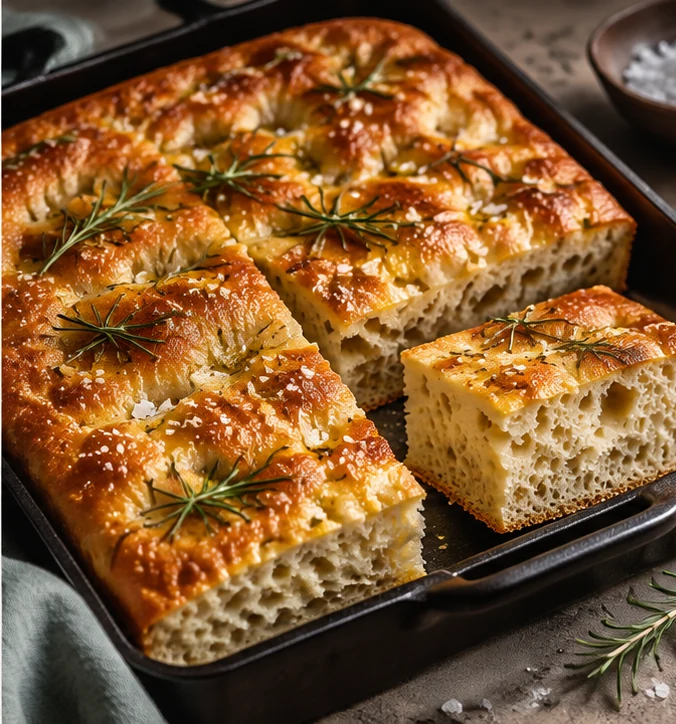
A golden, olive-oil-rich focaccia with a crisp, beautifully browned crust and an airy, tender interior. This high-hydration dough develops structure through gentle stretching and folding rather than traditional kneading.
Method
- 01
Mix the dough
Combine the flour, yeast, salt, and lukewarm water in a large bowl. Stir until no dry flour remains. Add the 30 g olive oil and incorporate thoroughly. The dough will be wet and sticky, more like a batter; this is intentional. Cover and rest for 20 minutes.
- 02
Develop the dough
With damp or lightly oiled hands, lift one edge of the dough, stretch it upward, and fold it over the center. Rotate the bowl and repeat on all four sides. Complete three rounds of stretching and folding, allowing 15–20 minutes of rest between rounds.
- 03
First rise
Cover and allow the dough to rise at room temperature for approximately 1–1½ hours, until noticeably expanded, airy, and soft.
- 04
Prepare the pan
Generously coat a 9 × 13-inch baking pan with 2–3 tablespoons of olive oil. Transfer the dough carefully, preserving its air bubbles. Gently stretch it toward the corners without forcing it.
- 05
Final proof
Cover and let the dough rise for another 45–60 minutes, until puffy and visibly aerated.
- 06
Dimple and season
Preheat the oven to 450°F (232°C). Drizzle the remaining olive oil over the dough. Using your fingertips, press deeply into the surface to create characteristic dimples. Sprinkle with flaky sea salt and fresh rosemary, if desired.
- 07
Bake
Bake on the middle rack, beginning to check at approximately 25 minutes. Expect roughly 25–35 minutes, depending on pan material and dough thickness. The focaccia is ready when the top is deeply golden, the underside well browned, and an instant-read thermometer inserted in the center registers 200–210°F (93–99°C).
- 08
Cool
Rest in the pan for approximately 5 minutes, then transfer to a wire rack to preserve the crisp bottom crust. Serve warm or at room temperature.
An everyday bread, your way
Sometimes perfection is the enemy of good. I often skip the folding and first rise, leave the whole bowl covered overnight, and do a single fold in the morning before transferring to the pan. It rises while the oven heats; then I dimple, season, and bake. Still so good, and much less time consuming.
Cast iron is preferred
A 9 × 13-inch cast-iron pan or 12-inch cast-iron frying pan develops a crisp, golden bottom crust. But don’t stress: a 9 × 13-inch glass or metal pan works just fine too.
High hydration
At 80% hydration, the dough is intentionally sticky and almost batter-like. Resist adding more flour.
Baking to temperature
Time is an estimate. Use the instant-read thermometer and crust color to judge doneness.
Serving and reheating
Enjoy with good olive oil. Refresh leftovers in a hot oven for a crisper crust.
Personal recipe · bake duration remains an estimate
 RECIPE 002Quiche Lorraine ↗